
Scott County Civil Docket Searches
For a Scott County civil docket search, begin with Missouri Case.net. It is the public index for the state's courts. You can search it by litigant name, filing date, case number, or scheduled hearings. If you call instead, the Scott County Circuit Clerk treats Case.net as the public search channel. The clerk will ask for a case number. Have that number ready when you can. Without one, verify the county, the party's role, the filing year, the case category, and the status before you trust that a name match is really your case.
Civil cases in Scott County sit in different divisions and categories. A hit from a search is a finding aid rather than a legal conclusion. A docket event may show that a petition, answer, motion, setting, or order was entered. Yet the underlying documents stay out of view. Give the clerk enough detail and staff can point you to the right access path and track down the case. What they cannot do is advise you on what to file or argue.
- Open Case.net and select the most useful search route: name, filing date, or case number.
- Apply the Scott County or 33rd Judicial Circuit location filter if the form provides one.
- Open the matching case and verify the civil category and each party's role.
- Read the entries from the newest setting or order back through the filing history.
- Use the Circuit Clerk's record-request channel if a specific document or certification is needed.
Note: A Scott County search that comes up empty might mean a spelling error, a wrong date, the wrong court, a timing lag, or an access limit. It does not prove no case exists.
Scott County Case.net Civil Searches
Timing matters on Case.net. The Scott County clerk says a 33rd Judicial Circuit-only search is real time once staff enter the information. An all-circuit Case.net search, by contrast, can lag by up to three hours. That gap explains why a fresh Scott County civil filing might not appear in an all-circuit query yet. The Missouri Courts' Track This Case instructions also cover optional case alerts. Alerts help, but they never replace a court notice or the current docket itself.
Missouri eFiling is a different animal. It is the filing route for registered users and authorized functions. It is not a second public docket database. The official Missouri eFiling information spells out how electronic filing, electronic case records, and public access fit together. For a Scott County civil lookup, Case.net is still the public starting point. The clerk and authorized courthouse access cover the rest.
Civil Dockets: What They Show
Think of a Scott County civil docket as the case's chronological register. Missouri's court-record rules treat docket or backer sheets as part of the official record, alongside filed documents. Access limits still apply. The entries can identify the parties, the case category, the filing date, and the court or division. They also list each docket event and setting along the way. Orders, dismissals, judgments, satisfactions, executions, and appeals all show up as entries too. The summary is genuinely useful. For exact terms, though, you need the actual order or a certified record.
| Case number | A locator built from the year, location, category, sequence, and subcase parts, such as YY-LOC-CV-00000-00. |
|---|---|
| Party role | Plaintiff or petitioner and defendant or respondent. A counterclaim can add separate plaintiff and defendant roles. |
| Filings and service | A petition, answer, motion, summons, service return, waiver, or related entry showing procedural progress. |
| Setting | A hearing, trial, motion date, case-management event, or other scheduled court action that can be changed later. |
| Judgment information | The judgment party, case number, date, court, amount, satisfaction or vacatur date, and summary concepts used in Missouri's judgment index. |
On a Scott County civil docket, service and return entries record that a procedural step happened. They settle nothing about the merits of the claim. Read a default, nonsuit, dismissal, judgment, garnishment, or satisfaction entry with the same caution.
Scott County Civil Case Codes
Missouri keeps an official case-type list. That vocabulary is what you will see in Scott County civil records. The examples here are code families. No rule says a given case must carry a particular code. A code simply points to the general record type. It cannot tell you who prevailed. It also cannot say whether the file is public, or whether every attachment is viewable from afar.
| Code family examples | General civil category | How to read it |
|---|---|---|
| CM, CN, CO, CP, CQ | Associate contract or money categories | Use the docket and filings to identify the actual claim and current stage. |
| CA, CB, CC, CD, CE | Circuit civil categories | Category letters assist the search; the court record supplies the details. |
| R1, RI, R2, RJ | Rent-and-possession or unlawful-detainer variants | Service, settings, and orders need to be read in sequence. |
| RS, RA, RW, RE, RG, RH | Lien, foreclosure, partition, or quiet-title examples | Check the listed case type instead of inferring it from one docket line. |
Scott County civil dockets also carry categories for domestic, name-change, adoption, probate, and protection matters. A general civil label never wipes out the special access rules that can attach to a family, adoption, or protected case. Note: the code names a category only; the docket and the controlling court documents hold the actual procedural details.
What Cases Fill the Civil Docket
The Scott County basic fee list names the filing categories that fill the civil docket: circuit civil, domestic, name change, conversion of legal separation, adoption, associate civil, small claims, garnishment, probate, and adult abuse or child protection, plus other types. Missouri's state case-type list adds finer detail. These labels help you recognize the kind of proceeding. Still, they settle no facts. Nor do they promise that every paper in the file is available.
- Contract and money matters can appear in associate or circuit civil categories.
- Real-estate matters can include liens, foreclosure, partition, and quiet title.
- Rent-and-possession and unlawful-detainer cases use their own case-type variants.
- Small claims follow a distinct Scott County petition and filing process.
- Domestic, adoption, and protection matters can carry added privacy limits.
- Probate filings can contain financial and identity information that needs separate access treatment.
A label on the Scott County civil docket tells you only so much. Read it with the case type, the division, and the most recent entry, since that context gives the label its real meaning for a civil record.
Scott County Small Claims Dockets
Scott County handles small claims on a simple form. The county's own small-claims petition fits on one page. It asks for the judge or division, case number, filing stamp, plaintiff and defendant, amount, date the claim arose, a short statement of facts, and a certification that the claim is true and unassigned. Those fields explain the shape of a small-claims docket. You may see the case style, the filing, service, a setting, and a judgment, but not the full factual statement behind the claim.
Fees come from the county's current list. Filing costs $35.50, and each filer is limited to 12 small-claims cases per calendar year. Certified-mail service adds $5.60 per defendant. Two more rules matter. The form states that a small-claims judgment cannot be appealed after 10 days and that no jury trial is available in this procedure. Since fee schedules and forms change, confirm amounts against the official Scott County fee sheet before you file or make a request.
A small-claims case is still a court record. The docket tracks the procedure. The underlying claim, the service record, a judgment, or a certified copy may require the right document channel.
Hearings on the Civil Docket
On the Scott County civil docket, a setting might be a hearing, a trial, a motion date, a case-management conference, a probate hearing, or a review. Case.net's scheduled-hearings route sorts by court or location and starting date, with filters for a judge, commissioner, or attorney. You can pull a single day or a seven-day display. Before trusting any result, confirm the case number, division, hearing type, and the most recent docket entry. A calendar hit alone proves nothing.
A setting is only scheduled, never held, until a docket entry says what happened. Continuances and resets happen. A vacated date can replace an older entry entirely. The Circuit Clerk asks callers for the case number. For any time-sensitive Scott County question, have it ready before you dial. The Scott County court schedule gives the wider context of court dates, while the case docket stays tied to one civil matter.
One habit is worth building. When a hearing date looks changed, start with the newest Scott County docket entry.
Scott County Rent Case Dockets
Rent-and-possession filings in Scott County follow the county's published instructions. Get the eviction notice from the sheriff first, then file. The Circuit Clerk hands out no forms for this process. After filing, the civil docket records the case. Entries cover the filing, service, return, settings, judgment, and enforcement steps. Treat them as court procedure, not as a full account of the facts or the legal rights involved.
Service and execution carry fees. The Scott County Civil Division page lists them. Summons, subpoena, and writ service cost $35 per person plus $15 mileage. Another summons to the same address adds $35. Garnishment runs $50. Property-seizure execution is $500. The fee PDF shows a different sheriff-service schedule, so verify amounts with the current office source before relying on either list.
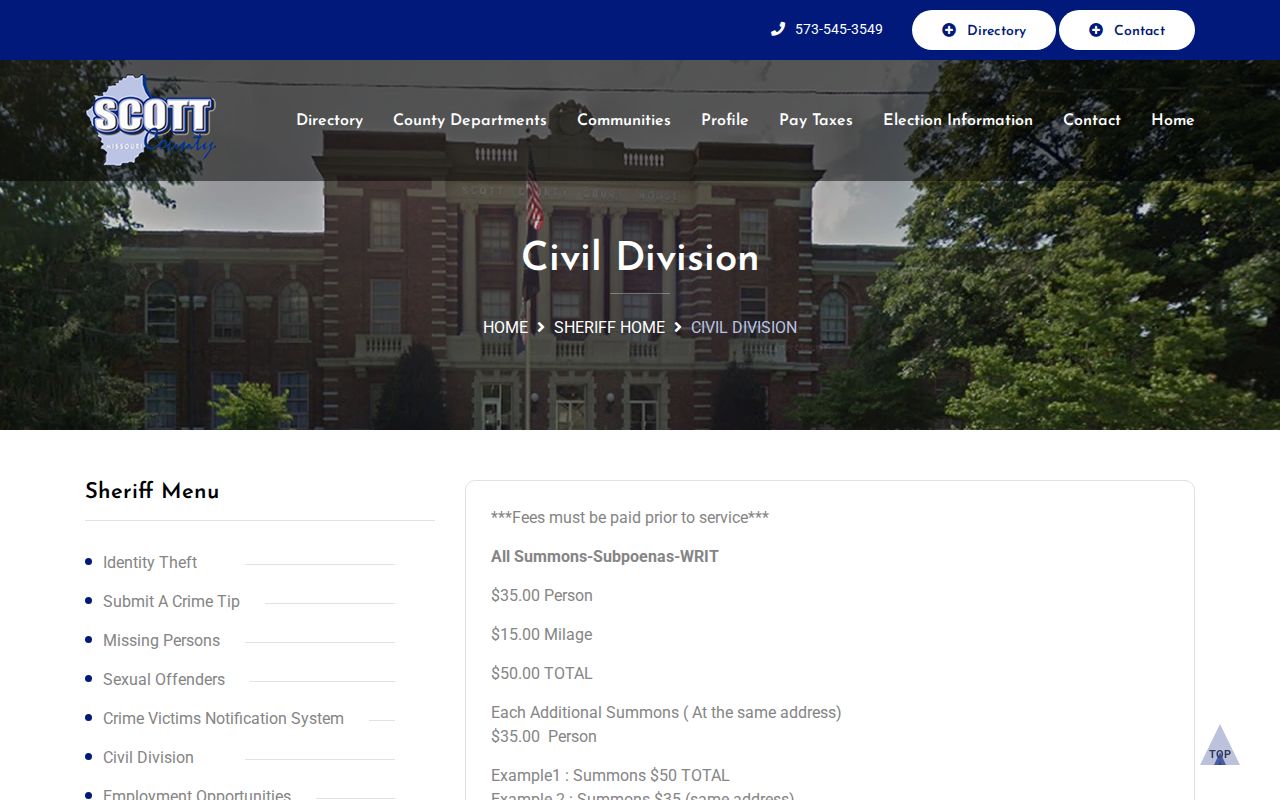
The sheriff's office handles the service and execution work. The Circuit Clerk keeps the docket for the civil case itself, and the Civil Division page keeps the two roles separate.
Who Can See Civil Dockets
Access to Scott County civil dockets comes in layers. Public indexes search by party name, case number, or filing date. The index does not open every document. Per the county, public court documents filed on or after July 1, 2023 are available remotely through Case.net. Redaction still applies. A docket line can show while its document does not. Security settings, filing date, format, or a restricted category can all change the result.
Access boundaries:
Missouri Rule 4 provides the statewide record, index, security, and public-access framework.
Missouri Rule 122.02 controls access and redaction for specified juvenile and family pleadings and orders.
Scott County's confidential-record inspection form is the official channel for access that cannot be supplied by an ordinary search.
Some case types need special handling. Family, adoption, juvenile, probate, and protection matters all qualify. The county's family-court notice points self-represented filers to approved Missouri forms and warns that unapproved forms can delay a case or lead to dismissal.
That notice covers filing procedure only. It neither makes a family file public nor authorizes disclosure of protected information.
Scott County Civil Record Copies
Sometimes a docket is not enough. Scott County answers with a record-request form. It separates ordinary copies from certified status, a raised certified seal, and an electronic certified seal. You supply the case number or enough detail to locate the civil record, plus the exact documents you want. A public PDF is never automatically certified. Name the certification you need rather than guessing.
Fees and timing sit on the form too. Expect a $5 copy fee before records go out. Allow 5 to 10 business days. You can submit by fax, mail, or the Circuit Clerk's official email route, with payment methods and any card fee spelled out on the form. Share sensitive identifiers only through that official process, and only when needed to locate or verify the record. One timing trap trips people up. The clerk's general docket-request estimate of 3 to 5 business days is a separate clerk timing, not a stand-in for the form's record-request window.
A certified judgment or order comes from the Scott County Circuit Clerk itself. Never infer one from a Case.net status or docket summary.